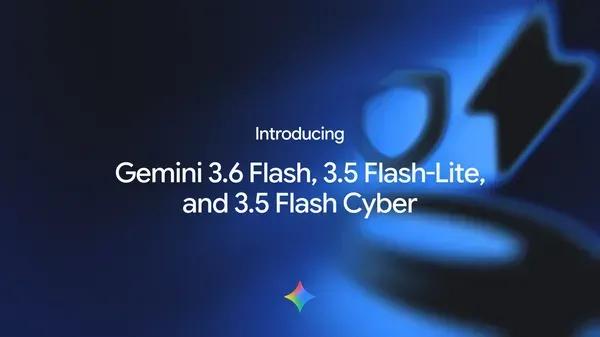
Google rolls out three lightweight AI models: 3.6 Flash (17% fewer tokens than 3.5 Flash), 3.5 Flash-Lite (350 tokens/second), and 3.5 Flash Cyber, reserved for governments. The first two are available today.
Models optimized for AI agents and cost efficiency
On July 21, 2026, Google announced three additions to its Flash lineup, designed to balance efficiency, latency, and cost in agentic workflows. The Gemini 3.6 Flash stands out with a 17% reduction in output tokens compared to 3.5 Flash, according to the Artificial Analysis Index. It also improves coding, financial analysis, and code migration tasks while being more cost-effective: $1.50/1M input tokens and $7.50/1M output tokens.
The 3.5 Flash-Lite, the fastest in the 3.5 series, reaches 350 tokens/second. Its price ($0.30/1M input, $2.50/1M output) and versatility make it a top choice for high-throughput tasks like document processing or agentic search. It even outperforms 3 Flash on some benchmarks, such as SWE-Bench Pro (54.2% vs 49.6%) or OSWorld-Verified (74% vs 65.1%).
A Cyber model reserved for governments
The 3.5 Flash Cyber, fine-tuned to detect and fix security vulnerabilities, will only be accessible via CodeMender, a Google DeepMind AI agent. This model, cheaper than large models, aims to give defenders an edge against dual-use risks. Its deployment remains limited to a pilot program for governments and trusted partners.
Context: a response to competition
These announcements come the day before Alphabet’s quarterly results, in a context where Google is being chased by Anthropic (Claude Mythos) and OpenAI (GPT-5.6). The California giant is banking on speed and cost to offset its lag in high-end models: the 3.5 Pro, in testing since May, still has no release date. Meanwhile, Google confirms it has started pre-training Gemini 4, described as its most ambitious project to date.
Availability and consumer use cases
The 3.6 Flash and 3.5 Flash-Lite models are now available to developers (API), businesses (Gemini Enterprise), and the general public (Gemini app). They now include the computer use tool to interact with user interfaces, such as code editors or design software. The 3.5 Flash-Lite is also offered in a free version for everyday tasks.
With these launches, Google confirms its strategy: targeting efficiency and accessibility over raw power. The battle for lightweight models is heating up, but the real test will come with Gemini 4 and Google’s ability to catch up with competitors on high-end performance.





Comments 0
Sign in to join the discussion.
Be the first to comment.