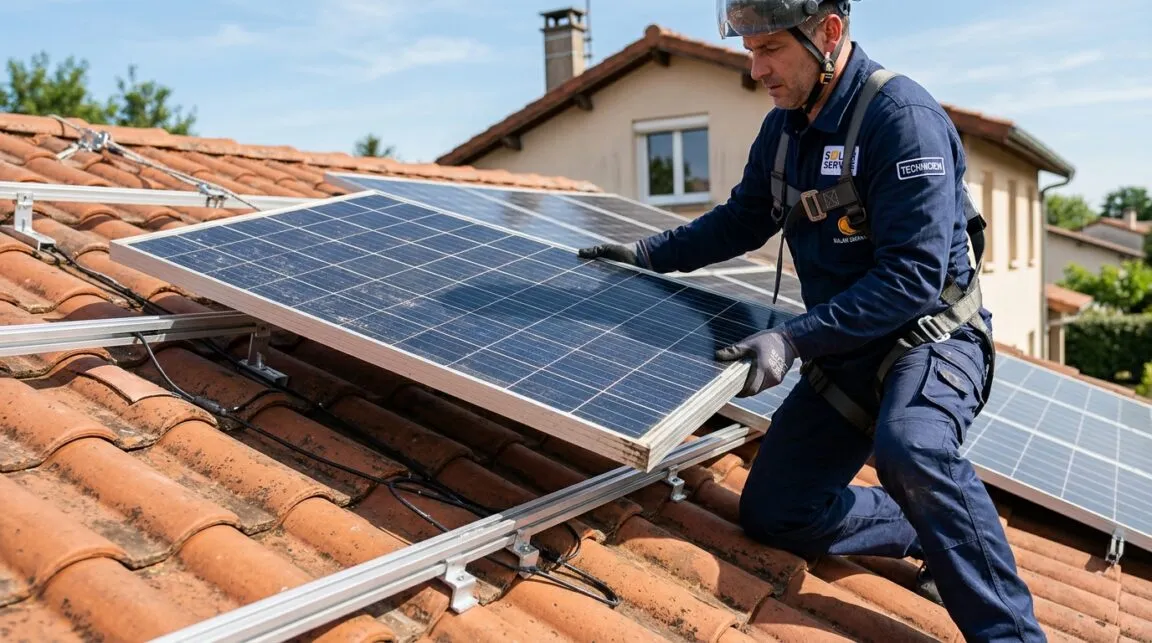
In France, end-of-life solar panels don’t end up in landfills. An organized sector collects and recycles over 90% of them, with a free service for individuals funded by manufacturers.
A regulated end-of-life, far from common misconceptions
Contrary to a persistent belief, a solar panel doesn’t suddenly stop working after 25 or 30 years. Its lifespan corresponds to a gradual decline in efficiency: beyond this point, it still produces energy, but at around 80% of its initial capacity. Some owners replace it with a more efficient model, while others use it until it stops working entirely. In both cases, the question of recycling arises.
The answer is clear: in France, used panels are predominantly collected and recycled. The glass, which makes up most of the weight, is separated and reused to produce new glass or construction materials. The aluminum frame, infinitely recyclable, is melted down for new uses. The silicon, the core of photovoltaic cells, is extracted through specific processes for reuse in industry. Even precious metals like silver or copper, present in small quantities, are recovered. Result: a solar panel is over 90% recyclable.
A mature and free system for individuals
This recycling sector isn’t a work in progress — it’s a well-established reality. Every panel brought to a recycling center or collected by an installer follows a precise path to a specialized treatment facility. Piece-by-piece dismantling maximizes material recovery.
Another key point: this service costs individuals nothing. It’s funded by a system where manufacturers and importers contribute to processing the waste they generate. No complicated steps or hidden fees: disposing of old panels remains a simple act.
 RecommendedSelf-reforming plastic breaks down at 90 °C, then reassembles
A circular economy in motion
Industries aren’t stopping there. They continuously improve dismantling techniques to recover even more raw materials at an ever-lower cost. The goal: reduce dependence on virgin resources by reusing materials from old panels to make new ones. A circular economy approach built for the long term, as France’s photovoltaic sector continues to expand.
If aging solar panels don’t end up as toxic waste mountains, it’s thanks to a solid organization. The question remains: will this model inspire other electronics sectors, which are still lagging in recycling?
Sciencepost — Après 25 ans sur nos toits, voici ce que deviennent vraiment les panneaux solaires


Comments 0
Sign in to join the discussion.
Be the first to comment.