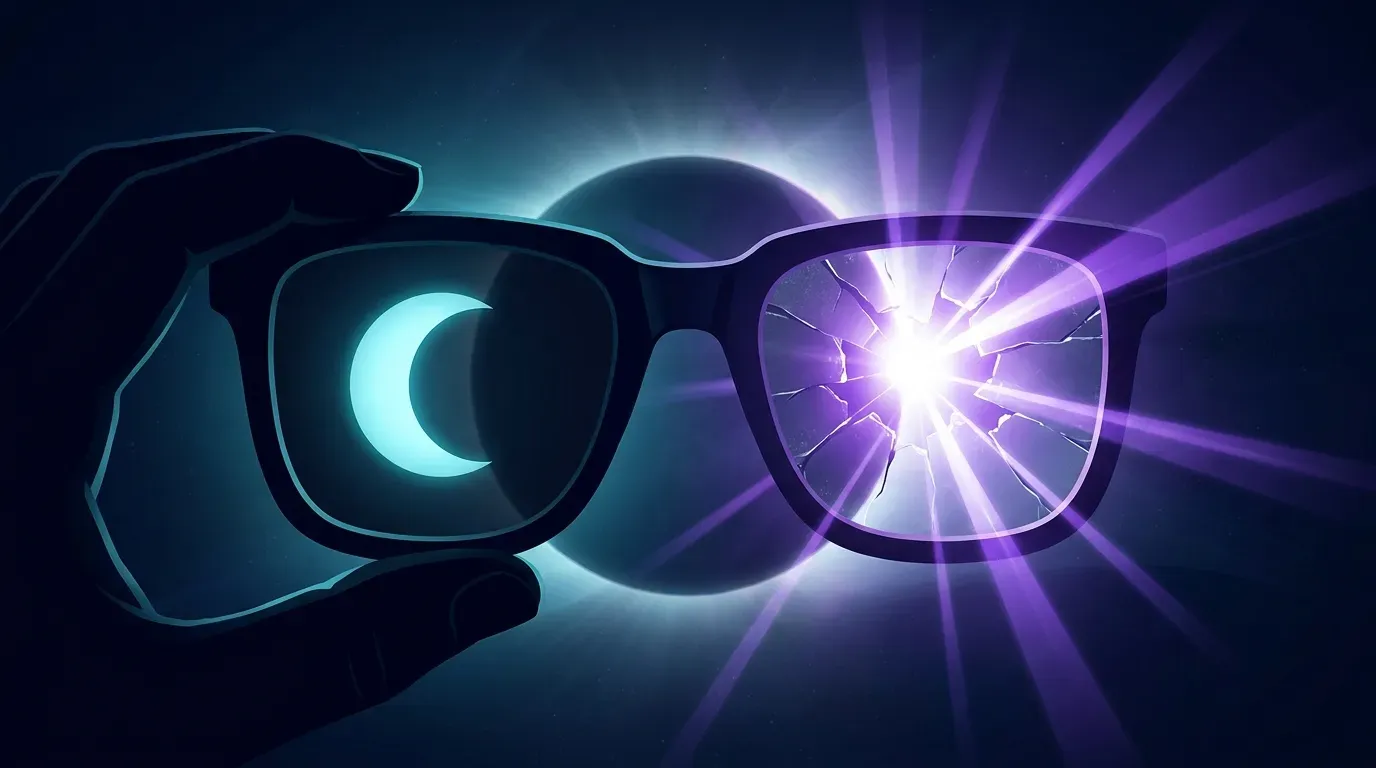
To safely observe the solar eclipse on August 12, 2026, certified glasses meeting the ISO 12312-2:2015 standard are essential. They filter 99.99% of sunlight and block UV and infrared rays. Without them, even a partial eclipse can cause irreversible eye damage.
Specialized glasses, not substitutes
Eclipse glasses are not interchangeable with welder’s lenses, lunar filters, or regular sunglasses. The latter, even very dark, allow 100,000 times more light than certified glasses, according to New Scientist.
Compliant models must bear the following markings: ISO 12312-2:2015(E), EN 1836:2005 + A1:2007, E15 or AS/NZS 1338.1:2012. These standards guarantee protection suitable for direct Sun observation, as noted by Sciences et Avenir.
Check filter condition before use
Even a micro-crack or scratch on the filter makes the glasses unusable. Before each observation, inspect them against an intense light source to detect any defects. Slight folds in the filtering film are normal, but any visible damage requires disposal. Children must be supervised, and those who have undergone eye surgery should consult a doctor before observing.
Where and when to observe the eclipse?
On August 12, a total eclipse will be visible in a narrow band crossing Greenland, Iceland, and northeastern Spain, with a maximum duration of 2 minutes and 18 seconds. In France, the eclipse will be partial, with up to 99.9% obscuration in Madrid or 92% in Paris, as detailed by Live Science.
Only during totality (when the Sun is completely obscured) can glasses be removed. Outside this zone or during partial phases, certified glasses must still be worn.
Alternatives if you don’t have glasses
- Use a pinhole projector: poke a small hole in a cardboard box and project the Sun’s image onto a white surface.
- Observe shadows cast by tree leaves or a perforated object (colander, straw hat).
- Reflect the Sun’s image with a mirror covered by a paper with a hole, then project the light onto a wall.
These methods avoid looking directly at the Sun but do not replace the protection of glasses for direct observation.
Where to buy reliable glasses?
Favor authorized retailers, such as those listed by the American Astronomical Society. Beware of counterfeits, especially online. The magazine Sciences et Avenir is also offering a special issue (July-August 2026) with certified Bresser glasses.
The August 12 eclipse is a rare event, but safety comes first. With proper glasses or projection methods, everyone can enjoy it safely. If the sky is cloudy, live broadcasts will be available, including via NASA or ESA.

Comments 0
Sign in to join the discussion.
Be the first to comment.