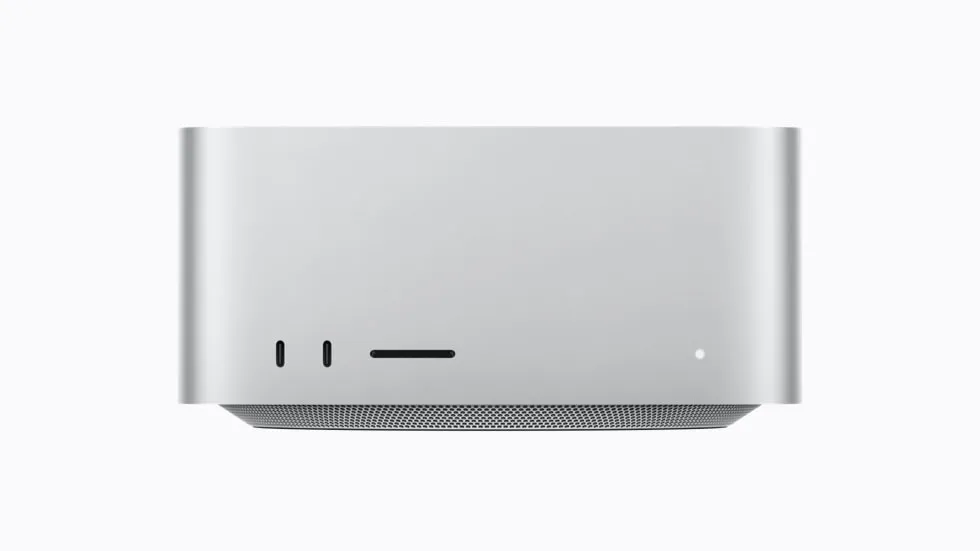
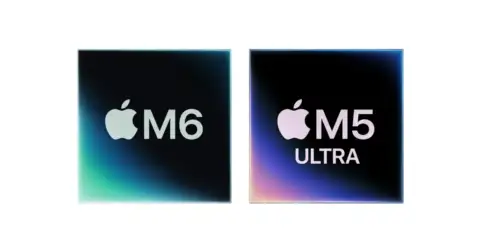
Apple reveals two new Apple Silicon chips: the M6, the first 2 nm chip, and the M5 Ultra, the brand’s first quad-die architecture. These components are now available in the new Mac mini and Mac Studio, delivering up to 4.3x better on-device AI performance compared to previous generations.
Chips designed for on-device AI
The M6 chip, built on a 2 nm process, is a first for Apple. It features a 12-core CPU (2 performance cores, 4 efficiency cores, 6 high-efficiency cores), a 12-core GPU with a neural accelerator per core, and a dual 16-core Neural Engine. The result: up to 4x faster AI performance compared to the Mac mini M4, and 2x faster graphics performance than the previous generation. Memory bandwidth reaches 170 GB/s, a 10% increase over the M5.
The M5 Ultra pushes boundaries with an unprecedented quad-die architecture: two M5 Max chips (already dual-die) are connected via UltraFusion, offering inter-die bandwidth of 4.4 TB/s. It packs up to 36 CPU cores (12 performance cores, 24 efficiency cores), 80 GPU cores with neural accelerators, and a 32-core Neural Engine. Its memory bandwidth peaks at 1.2 TB/s, with up to 512 GB of unified RAM — a setup that enables running cutting-edge AI models entirely on-device.
Mac mini and Mac Studio: Machines optimized for AI
The Mac mini M6, starting at €1,049, targets on-device AI users and developers. It offers 3 Thunderbolt 4 ports, 16 GB of unified RAM (up to 32 GB), and AI performance 4x faster than the M4. The Mac mini M5 Pro, at €1,999, steps up with an 18-core CPU, a 20-core GPU, 64 GB of RAM, and Thunderbolt 5, essential for machine clustering.
The Mac Studio comes in M5 Max (starting at €2,999) and M5 Ultra (€6,599) configurations. The M5 Max model features an 18-core CPU, a GPU with up to 40 cores (50% faster than the previous generation), and 128 GB of RAM. The M5 Ultra, with its 80-core GPU and up to 512 GB of RAM, can run AI models with hundreds of billions of parameters on-device. Both versions include Wi-Fi 7, Bluetooth 6, and an SSD up to 2x faster thanks to a PCIe Gen 6 architecture.
Clustering and pro connectivity
Apple is betting on clustering for intensive AI workloads. With Thunderbolt 5 and RDMA (Remote Direct Memory Access), up to four Mac Studio units can be connected to form a mini AI server. A cluster of four machines delivers up to 3x the inference performance of a single unit. The Mac Studio M5 Ultra also supports up to 8 displays, or 4 Studio Display XDR in 5K at 120 Hz.
On the software side, macOS 27 Golden Gate and the Core AI, MLX, and Xcode frameworks optimize AI model execution on these new chips. Apple Intelligence, with Siri AI, is integrated for tasks like image generation, photo editing, or workflow automation.
 RecommendedMeta Launches Mac App for Its AI with Screen Sharing and Dictation
Availability and pricing
Pre-orders for the Mac mini and Mac Studio have been open since August 25, 2026. Deliveries begin on September 22. The 512 GB RAM configuration for the Mac Studio M5 Ultra will not be available until late October.
With these new chips, Apple confirms its strategy: making on-device AI accessible and high-performing, without relying on the cloud. The M6 and M5 Ultra, paired with machines like the Mac Studio, position the brand as a key player for developers and AI professionals.
Sources
Presse-citron — Apple présente un Mac mini 4 fois plus puissant en IA
Apple Newsroom — Apple introduces new Mac Studio with M5 Max and M5 Ultra
Apple Newsroom — Apple introduces M6 and M5 Ultra for a big leap in performance and AI compute
Numerama — Apple dévoile la puce M6 avec de nouveaux Mac mini et Mac Studio



Comments 0
Sign in to join the discussion.
Be the first to comment.