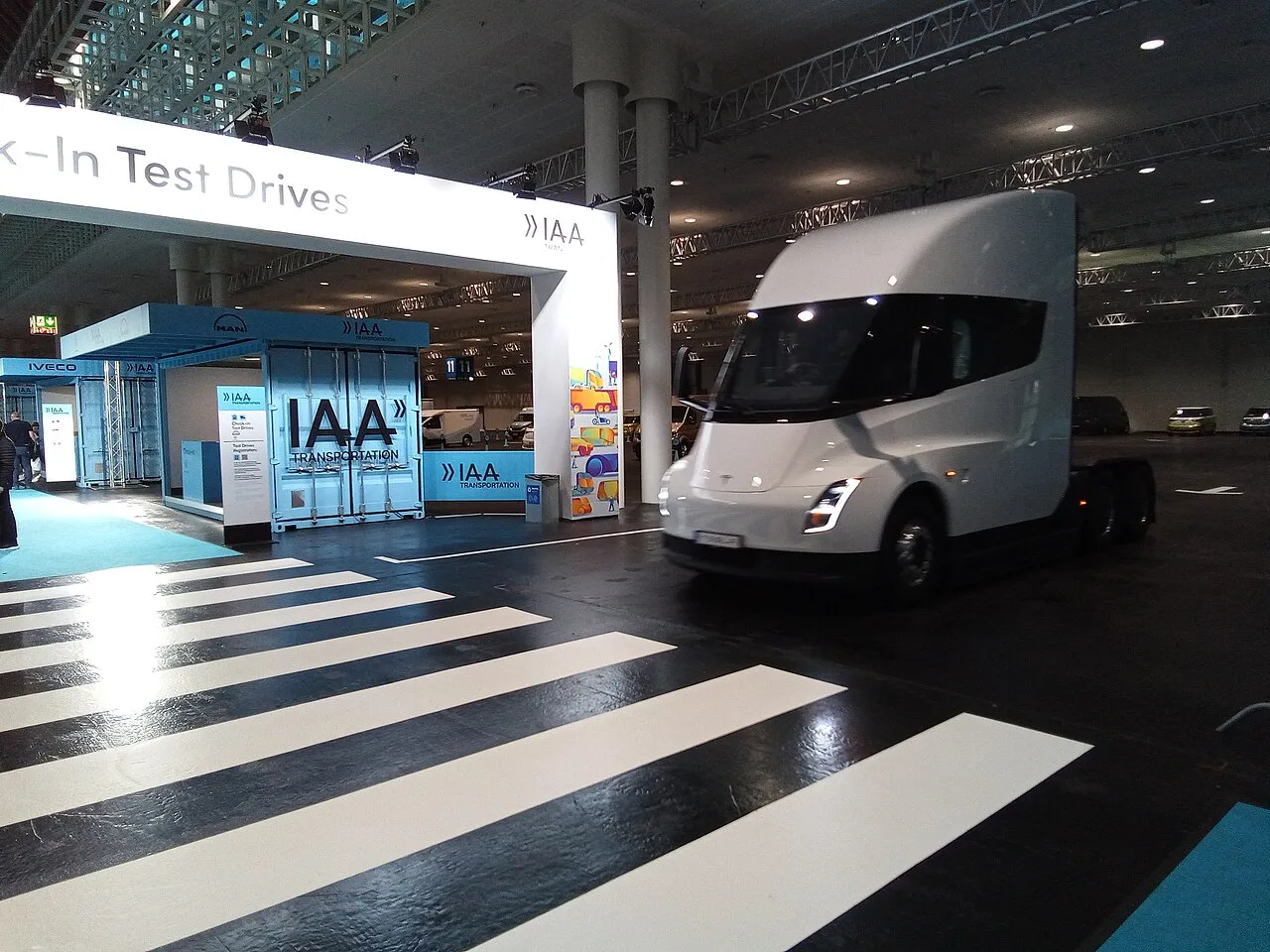
Tesla will reveal the specifications and European launch timeline for its Semi at IAA Transportation in Hanover, September 15–20, 2026. Meanwhile, in the US, the dedicated Nevada factory is set for inauguration after already starting volume production.
Europe to get its answers in September
The manufacturer has confirmed its presence in Hanover to present the technical specifications, prices, and commercialization timeline for the Semi in Europe. A model will be on display, but several questions remain unanswered: which versions will be offered, where will the trucks be assembled, and how does Tesla plan to deploy its charging network?
In the US, Tesla offers two versions: a Standard Range (523 km range) and a Long Range (800 km). Both use three electric motors (800 kW, or 1,070 hp) and support ultra-fast charging via the MCS connector, capable of restoring 60 to 70% of range in 30 minutes. This standard, currently being rolled out in Europe by players like Milence or Iberdrola, could facilitate the Semi’s arrival.
Nevada plant ramping up production
Tesla will officially inaugurate its Semi-dedicated plant in Sparks (Nevada) on September 24, 2026. This 1.6 million-square-foot site, adjacent to the Gigafactory Nevada, has a theoretical annual capacity of 50,000 trucks. Mass production, however, already began in April 2026, with deliveries to early customers like PepsiCo or Einride.
Analysts estimate Tesla will deliver between 5,000 and 15,000 Semi trucks in 2026, far below the 50,000-unit potential. Dan Priestley, director of the Semi program, confirms that production is "ramping up" after the line’s April launch. The September inauguration will also serve to reset expectations on actual volumes.
A competitive European market
Tesla is entering a market where traditional manufacturers have already gained a foothold. Mercedes-Benz offers the eActros 600 (500 km range), MAN the eTGX (up to 570 km), and Volvo, Scania, Renault Trucks, or DAF already market electric models. The Semi Long Range, with its announced 800 km range, could stand out on paper, but its real-world range with a loaded trailer remains to be verified.
Another challenge: infrastructure. Tesla’s Megacharger network, tailored for heavy-duty vehicles, does not yet exist in Europe. The MCS standard, compatible with the Semi, is starting to emerge, but large-scale deployment will take time. Fleet managers may also question the lack of a dedicated Tesla dealership network for heavy-duty vehicles, unlike Mercedes or Volvo.
 RecommendedTesla Semi: European specs and timeline coming in September
Orders piling up, but outside Europe
Einride, a Swedish company specializing in sustainable transport, has placed the largest order to date: 500 Semi trucks, deliverable starting September 2026. These trucks will be deployed in North America, on routes connecting California, New Jersey, Texas, Illinois, and Georgia, for clients like Amazon.
“This deployment proves we can meet large-scale customer demand. Working with Tesla to rapidly integrate next-gen Semi trucks into our operations demonstrates the maturity of this technology.” — Roozbeh Charli, CEO of EinrideTranslated from French
“Electric trucks offer lower costs per kilometer thanks to fuel savings, reduced maintenance, and better uptime compared to diesels. These savings scale with large-scale deployment.” — Dan Priestley, Tesla Semi program directorTranslated from French
Tesla is banking on two advantages for its Semi: superior range compared to competitors and an attractive total cost of ownership. But in Europe, the manufacturer will also need to convince on charging, maintenance, and logistics. Concrete answers are expected in Hanover.







Comments 0
Sign in to join the discussion.
Be the first to comment.