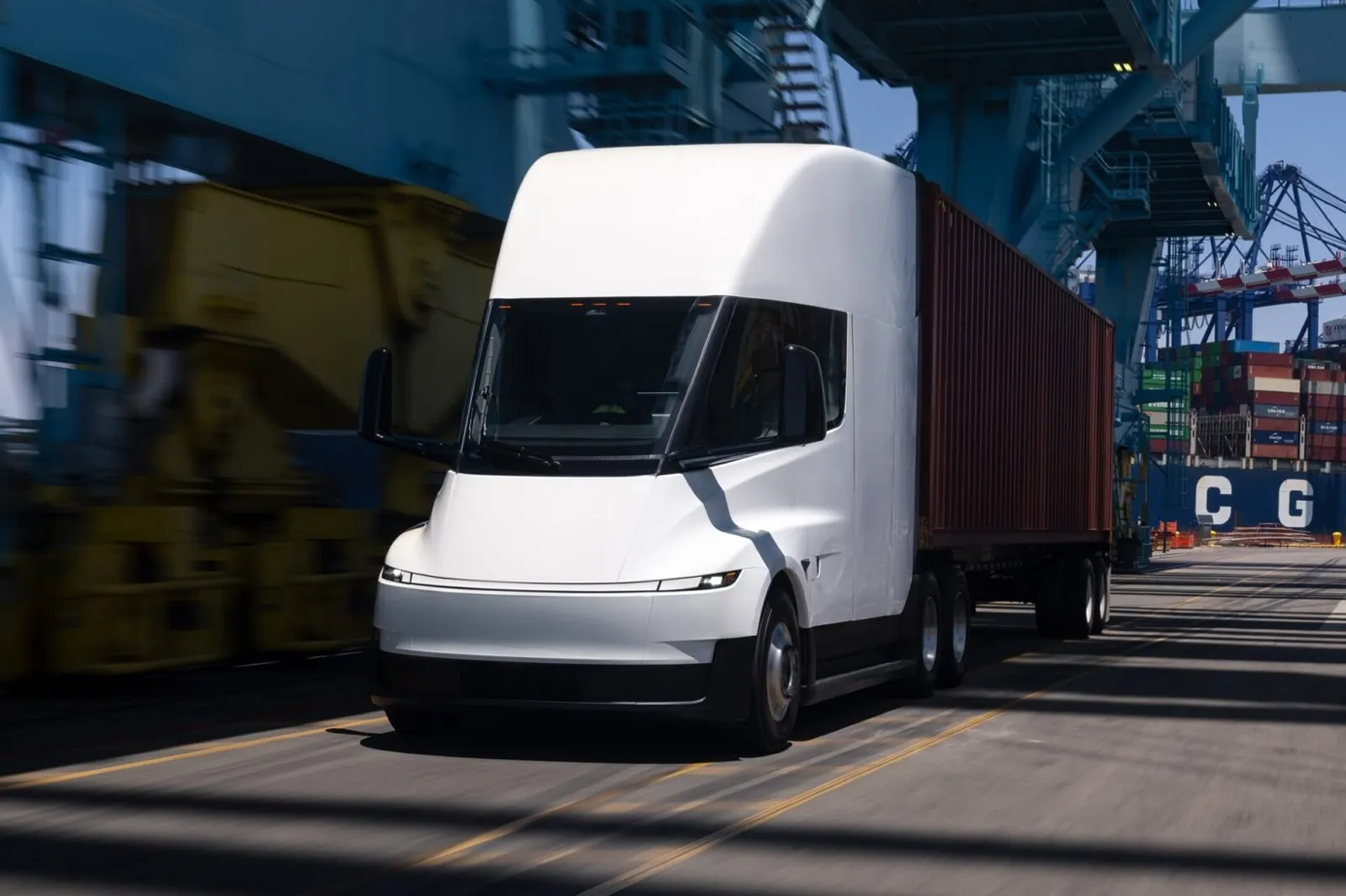
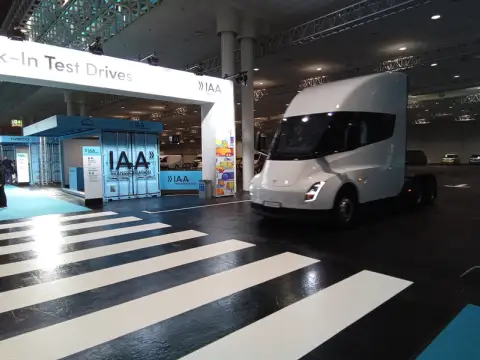
Tesla will reveal the technical specifications and European launch timeline of its Semi at the IAA Transportation show in Hanover, from September 15 to 20, 2026. The electric truck, awaited since 2017, enters a market already dominated by Volvo, Mercedes and Renault Trucks.
An official announcement, but few details
The manufacturer confirmed by email on August 20 that the Semi will be presented in Europe at the German trade show. No technical specs, prices, or commercial launch dates have been disclosed yet. The only certainty: a model will be on display in Hanover, and answers to carriers’ questions should be provided there.
In the US, the Semi comes in two versions: a 523 km range (Standard Range) or 800 km (Long Range), with 1,072 horsepower and charging up to 1.2 MW on dedicated Megachargers. US prices are $260,000 for the base model and $290,000 for the Long Range.
A mature European market
In Europe, local manufacturers didn’t wait for Tesla. Mercedes-Benz already offers the eActros 600, with 621 kWh of battery and a 500 km range, while Volvo Trucks, Renault Trucks, MAN, Scania, and DAF sell heavy electric trucks, with established after-sales service networks. The Milence consortium, led by Volvo, Daimler, and Traton, is also deploying MCS (Megawatt Charging System) stations along major European routes.
Electric trucks accounted for 4.8% of registrations in Europe in the first half of 2026, up 47.7% year-on-year. Despite this growth, diesel still dominates with 92.1% of sales.
Tesla’s challenges: adaptation, charging, and network
The Semi will need to adapt to European constraints: maximum length of road trains, turning radius, and Megacharger homologation, as the MCS standard takes hold on the continent. The European version could thus differ from the US model, particularly in terms of range, since Europe’s permitted weights (40–42 tons) exceed those in the US (37 tons).
Another hurdle: the network. Tesla will need to build a dedicated after-sales and charging infrastructure, while its competitors rely on decades of local presence. Production, currently limited by 4680 batteries, remains a weak point: the Nevada plant, designed for 50,000 units per year, struggles to meet US demand.
Rumors suggest European production at Gigafactory Berlin, but nothing is confirmed. Without this, Tesla will start with a logistical disadvantage against established players like Volvo or Mercedes.
 RecommendedHyundai Ioniq 3 pricing hints at French launch vs Renault 5 E-Tech
What carriers are watching
For professionals, three criteria are key: price, parts availability, and charging network density. TCO (total cost of ownership) remains the decisive factor. Tesla is banking on its aerodynamics, battery management software, and energy efficiency, but must prove it can deliver flawless service at a continental scale.
“Fleet managers swear by one metric: TCO. Residual value, 24-hour spare parts availability, and garage network density take priority over everything else.”Translated from French
The Hanover trade show will be a test for Tesla: can it convince European carriers, accustomed to historic players, with an adapted product and a network up to the task? The answers, awaited since 2017, should finally arrive in mid-September.





Comments 0
Sign in to join the discussion.
Be the first to comment.