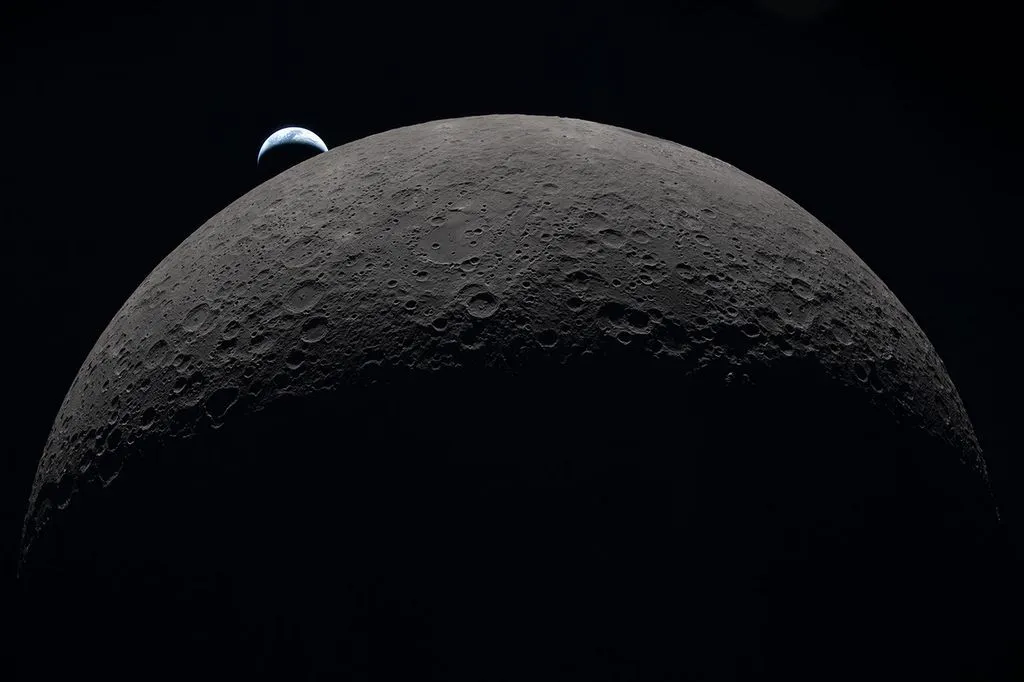
A SpaceX rocket upper stage struck the Moon on August 5, 2026, creating an 18-meter-wide crater less than 3 meters deep. NASA’s LRO probe captured the first detailed images between August 11 and 12.
A calculated impact, a meticulous observation
The crater resulted from the impact of a Falcon 9 upper stage, launched in January 2025 for the Firefly Blue Ghost 1 mission. The collision occurred on August 5, 2026. To observe it, the Lunar Reconnaissance Orbiter (LRO) probe had to adjust its trajectory: it orbits the Moon at an altitude of 97 km, traveling at 1.6 km per second. Each polar orbit lasts two hours, but the Moon’s slow rotation required a six-day wait before the site became visible.
Precision was critical. A 10-second delay in imaging would have shifted the crater 16 km from the center of the image. Engineers used LRO’s narrow-angle camera, capable of resolving details as small as 1 meter, to capture the site under different lighting angles.
A crater and its revealing traces
The images show a crater 18 meters in diameter, with a depth of less than 3 meters, estimated using the shadow cast. Around it, dark and light streaks extend. The dark streaks, composed of dust and rocks altered by solar wind, cosmic rays, and micrometeorites, come from the top 46 centimeters of the lunar surface. The brighter streaks correspond to fresh material extracted from deeper layers.
International coordination to locate the impact
Locating the site involved both amateur astronomers and experts. Independent astronomers first identified the stage’s trajectory using public data. NASA’s Center for Near-Earth Object Studies (CNEOS), based at the Jet Propulsion Laboratory, refined these calculations to predict the impact point. These coordinates were shared with the South Korean Danuri probe team, which confirmed the prediction’s accuracy to within 1 km using its high-resolution LUTI camera.
Danuri then shared the exact coordinates with the LRO team, enabling refined follow-up images. The crater is located at 19.4759°N, 266.7138°E, at an altitude of 511 meters. Before-and-after images confirmed the location.
 RecommendedStarship’s 13th test flight deploys Starlink V3 satellites but remains partial
A test for planetary defense
CNEOS, which typically tracks potentially hazardous asteroids and comets for Earth, used this event to test its impact prediction tools. It was an opportunity to validate methods applicable to threatening natural objects.
This unintentional impact highlights that the increasingly busy lunar space is becoming a study ground for the consequences of space debris. The data collected by LRO and Danuri could inform future protocols for managing end-of-life objects.






Comments 0
Sign in to join the discussion.
Be the first to comment.