On August 5, 2026, a SpaceX Falcon 9 upper stage crashed into the Moon at 8 700 km/h. The resulting dust plume may have been visible from Earth, particularly from South America.
A predicted and documented impact
The 4-ton upper stage had been launched on January 15, 2025, to carry two private lunar landers: Blue Ghost 1 (Firefly Aerospace) and Resilience (ispace). After its mission, it remained in unstable Earth orbit for 19 months before heading toward the Moon. The impact occurred near the Einstein crater, on the visible side, at 08:35 (Paris time).
The impact speed was 2.43 km/s (8,700 km/h), at a 34-degree angle from vertical. The energy released was equivalent to three tons of TNT. According to Los Alamos National Laboratory simulations, the stage lifted between 150 and 200 times its own mass in regolith (lunar dust), or about 1.12 million kilograms. The highest fragments reached 1.5 km in altitude, and the fastest ejecta may have fallen up to 1,000 km from the impact point.
A crater and a plume observed
The resulting crater measures between 18 and 30 meters in diameter and 3.5 to 5 meters deep. The first images were captured by the Korean orbiter Danuri, which flew over the area before and after the impact. The Cerro Paranal Observatory (Chile) detected spectral lines of sodium and lithium gas in the dust plume, visible for 5 to 10 minutes after the collision.
Ground-based telescopes, such as the Very Large Telescope and Apache Point, attempted to capture the plume from South America, where night was still in effect. In France, direct observation was nearly impossible due to daylight. Detailed images of the crater, taken by NASA’s Lunar Reconnaissance Orbiter, are expected within one to two weeks.
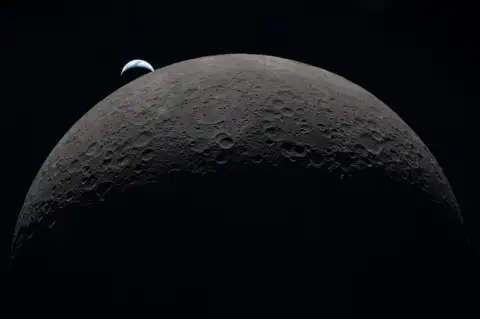 RecommendedNASA captures crater from SpaceX Falcon 9 stage on the Moon
Why this impact interests scientists
This event provides a rare opportunity to study the effects of a high-speed impact on the Moon. The collected data will help test crater formation models, debris projection, and shockwave propagation. This knowledge is crucial for designing safer landers and lunar bases as part of NASA’s Artemis program.
Analyzing the dust plume, composed of regolith and rocket materials, also helps understand the composition of the lunar soil. Detailed results are available in the study published on arXiv by the Los Alamos National Laboratory team.
While the impact was not spectacular for the general public, it marks a milestone for space research. Even abandoned orbital debris can become unexpected scientific tools.


Comments 0
Sign in to join the discussion.
Be the first to comment.