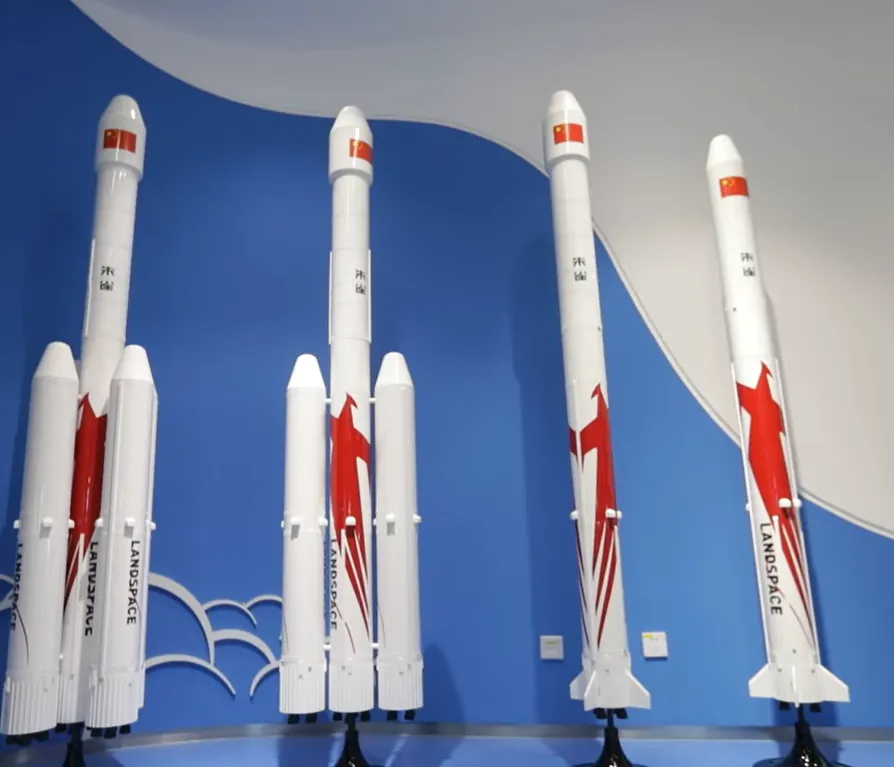
China successfully landed the first stage of its Zhuque-3 rocket on the ground on Tuesday, August 19, 2026, a first for the country after a sea recovery in July. This milestone, achieved by private company LandSpace, confirms the acceleration of China’s space sector in reusable launchers.
A controlled landing in the Gobi Desert
Liftoff occurred at 7:35 (UTC+8) from the commercial zone of Dongfeng, in the Gobi Desert. After placing a satellite into orbit, the 66-meter-tall first stage, powered by nine methane engines, began its descent. It traveled 390 km before performing a powered landing on four deployable legs in a prepared area. LandSpace, founded in 2015, called the mission a "complete success."
This recovery marks two firsts for China: the first on-land landing of an orbital stage and the use of landing legs, previously reserved for sea recoveries such as that of the Long March 10B on July 10, 2026, captured by a net on an offshore platform.
Proven technology, challenges ahead
LandSpace made modifications to its launcher after a failed first test in December 2025, when the stage crashed. Adjustments included using a single engine for the final landing phase and reinforcing the heat shield. Dai Zheng, Zhuque-3 project lead, explained that the final braking maneuver enabled a "soft landing," achieving the goal of a "one-step reverse" at high speed.
"This mission lays the groundwork for the next steps: post-recovery inspection, maintenance, reuse, and commercial applications." — LandSpace, official statementTranslated from French
The Zhuque-3, capable of placing 8 tons into low orbit in reusable mode, is expected to see its capacity increased to 18.3 tons with an improved version. LandSpace aims for at least 20 reuses per stage but has not specified a timeline for the first reused flight. CASC, for its part, plans to reflight the Long March 10B by the end of the year.
China’s space sector in full transformation
China now has multiple players developing reusable rockets, both public (under CASC) and private. After the failures of December 2025, the recent successes of the Long March 10B and Zhuque-3 show rapid progress. Other launchers, such as the Long March 12A, Pallas-1 (Galactic Energy), or Tianlong-3 (Space Pioneer), are expected to attempt recoveries in the coming months.
This momentum is part of a context of massive satellite constellation deployment. Projects like Guowang and Qianfan, for example, will require between 700 and 800 launches over the next 7 to 10 years, according to Chinese estimates. Reusable launchers could reduce costs and accelerate mission frequency.
 RecommendedNASA captures crater from SpaceX Falcon 9 stage on the Moon
Comparison with the US: is the gap closing?
In the US, SpaceX dominates the market with its Falcon 9, reused up to three times a week on average. Blue Origin, with New Glenn, has also achieved recoveries, but its launcher is currently grounded after an incident in May 2026. Other US players (Rocket Lab, Relativity Space, etc.) struggle to match SpaceX’s pace, which plans to retire the Falcon 9 by 2028 in favor of Starship, still in the experimental phase.
While China still lags behind SpaceX in launch numbers, its space sector, combining public and private actors, shows a rapid capacity for innovation. Reusability could help it close part of the gap.
With two successful recoveries in less than two months, China has proven it now masters the key technologies of reusability. The next step will be to demonstrate the speed and reliability of reuses, a challenge that even SpaceX took years to overcome.


Comments 0
Sign in to join the discussion.
Be the first to comment.