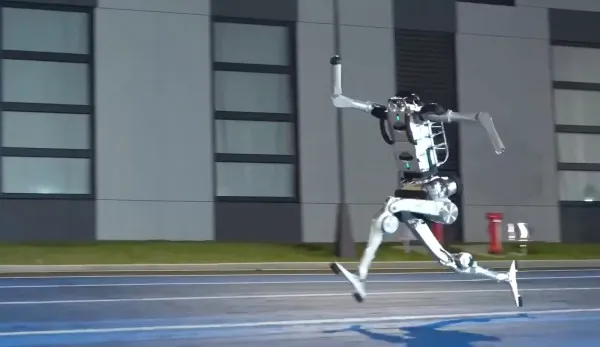
A Chinese humanoid robot, Superman, hits 45.6 km/h, surpassing Usain Bolt’s 44.72 km/h record. However, these track-filmed performances lack independent verification, and the machines struggle to brake or perform complex tasks.
45.6 km/h: a record to qualify
On August 17, 2026, Unitree released a 30-second video of its headless, handless robot Superman running at 12.66 m/s (45.6 km/h) on an athletics track. This peak speed exceeds the 12.42 m/s Usain Bolt achieved in his 2009 100 m world record. The same model also performs a 2-meter vertical jump, 2.5 times the length of its 85 cm legs.
Yet these figures are not validated by a third party. Unitree does not specify the measurement method, the robot’s weight, or the track conditions. Moreover, a peak speed does not equate to a timed 100 m performance: robots struggle to maintain balance and decelerate. Several videos from the World Humanoid Robot Games, held in Beijing from August 22 to 26, 2026, show machines crashing into barriers or catching fire after crossing the finish line.
Robot Olympics to showcase progress
During these Games, two other robots beat the human 100 m record: Tiangong Ultra, from the Beijing Humanoid Robot Innovation Center, runs in 8.86 s, and Lightning, developed by Honor, in 9.32 s in trials and 9.47 s in competition. These times, faster than Bolt’s 9.58 s, highlight the rapid acceleration of China’s robotics sector. In 2025, the best robotic time was still 21.50 s.
But these performances mask technical limitations. Robots are often specialized for a single task: sprinting in a straight line, unable to brake or turn. Some are even teleoperated by humans, reducing their autonomy. Less spectacular events, such as stacking books or extinguishing fires, reveal persistent difficulties in fine manipulation and adapting to the unexpected.
 RecommendedChina blocks Meta’s $2B Manus acquisition: deal collapses
A spotlight before going public
The Superman video comes at an opportune time: Unitree goes public on August 19, 2026, on Shanghai’s STAR Market, raising €830 million at an €8 billion valuation. The Hangzhou-based company had announced in early 2026 its plan to commercialize robots capable of outrunning human sprinters. It had already dominated the first Games in 2025 with four gold medals.
Superman remains an experimental prototype. Its development took three months, and Unitree acknowledges that stability, motion control, and energy efficiency still need improvement. The robot relies on lightweight legs, without upper limbs, to maximize propulsion.
“Briefly hitting a peak speed is not the same as running a timed 100 m.”Translated from French
Chinese humanoid robots cross a symbolic speed milestone, but their real-world utility remains unproven. Technical challenges — autonomy, versatility, safety — remind us that the race for records does not (yet) make an operational robot.
Sources
Science & Vie — Ce robot court à 45,6 km/h et fait des bonds de 2 m
Wired — The Humanoids at China’s Robot Games Were Faster Than Usain Bolt
Ars Technica — World humanoid robot games show runners breaking records, bursting into flames
La crème du gaming — Un robot humanoïde chinois bat le record d’Usain Bolt sur 100 m


Comments 0
Sign in to join the discussion.
Be the first to comment.