XPeng has begun production of its Iron humanoid robot on a line over 80% automated in Guangzhou. Unlike Tesla, whose Optimus struggles to move from prototype to mass production, the Chinese firm has a concrete lead: the first unit left the line unassisted on September 8, 2026.
A production line built for robots, not adapted
The Guangzhou line is presented as the world’s first dedicated to the automated assembly of advanced humanoid robots. Over 80% of key steps are handled by machines, with quality standards directly inspired by XPeng’s automotive industry. The manufacturer is thus repurposing its expertise: 85% of the supply chain is shared with its electric vehicle division.
The Iron robot, standing at 173 cm and weighing 65 kg, has 76 degrees of freedom (down from the initially announced 82), including 21 per hand for enhanced dexterity. Its three in-house Turing chips provide a combined 2,250 TOPS of power, enabling its AI model to run locally without cloud dependency. The result: reduced latency and full autonomy for complex tasks.
Tesla lagging, XPeng leading
Tesla, which had promised 10,000 Optimus units by 2026, admitted in January 2026 that none were yet performing "useful work." Elon Musk has since converted an automotive production line in Fremont for the robot, but scaling remains "very gradual." XPeng, however, designed its line from the start for Iron and aims for mass production by the end of 2026.
The first Iron units will be deployed internally in XPeng showrooms and on its campuses by the end of 2026. Large-scale commercialization, initially targeting China and then international markets, is planned for 2027, with applications in service and retail. The group expects gross margins per robot to exceed those of its electric vehicles, though it has not released specific figures.
Funding and technical challenges
XPeng’s robotics subsidiary, Dogotix, raised $900 million in August 2026, valuing it at over $6.3 billion. This is the largest funding round ever in China for embodied AI and will fund industrial scaling. XPeng also reported a gross margin of 20.7% in the last quarter, compared to Tesla’s 16.8%.
However, technical adjustments have been noted: the degrees of freedom were reduced from 82 to 76, and rumors suggest difficulties in sourcing all-solid-state batteries, forcing XPeng to use semi-solid technology. Additionally, two key robotics unit executives left the company shortly before the launch, prompting CEO He Xiaopeng to take direct control.
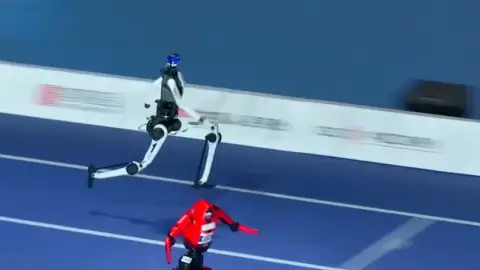 RecommendedChinese automakers race to build humanoid robots
A robot designed for the real world
Iron is presented as a "high-level generalist" robot, capable of receiving instructions, planning strategies, navigating intelligently, and avoiding obstacles without trial and error. It also features an auto-recharge function: it locates a dedicated station and plugs in on its own. Its design, with a fabric skin and a structure inspired by the human spine, aims to make its movements more natural.
XPeng is betting on full synergy between its businesses: Iron’s physical AI model is the same as the one used for its cars and flying car prototypes. This "end-to-end" approach (AI model, data infrastructure, computing power, robot body, and production system) is a claimed advantage over competitors.
While XPeng has scored an industrial point, the real test lies ahead: proving Iron can find practical use and sell. Tesla still has time to catch up. For now, though, it’s the Chinese firm setting the pace.
Sources
Numerama — XPeng lance la première ligne d’assemblage automatisée pour ses robots humanoïdes
Génération NT — Tesla Optimus en retard ? Le robot de XPeng vient de sortir de sa chaîne de montage
Live Science — Eerily humanlike AI-powered robot enters mass production in China
CleanTechnica — XPENG IRON Autonomously Walks Off Production Line
Comments 0
Sign in to join the discussion.
Be the first to comment.