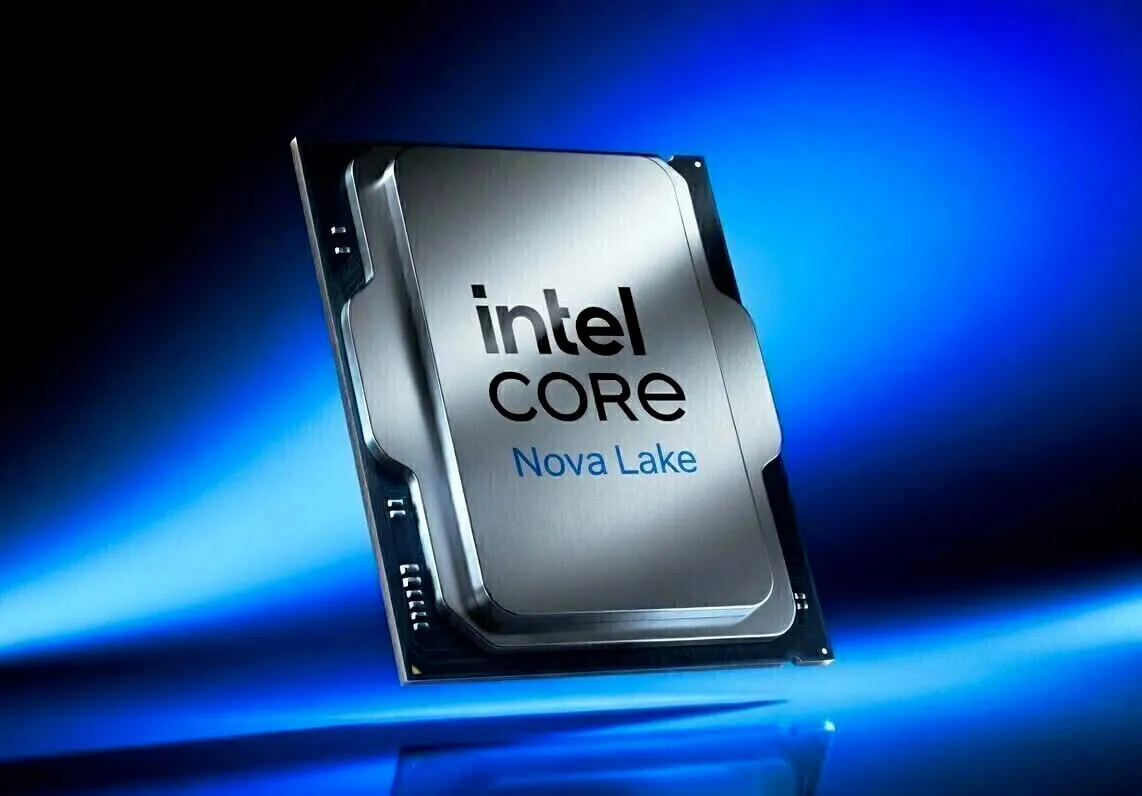
Intel prioritizes gamers and desktop PCs for its new generation of cores Nova Lake, unlike AMD, which started with servers using Zen 6. Robert Hallock, Intel’s vice president, urges enthusiasts to "do the math" on this strategy.
Nova Lake: desktop first, data centers later
Intel has officially confirmed that its new Nova Lake CPU cores will first arrive on desktop PCs before being adapted for data centers. This announcement, made by Robert Hallock, vice president and general manager of the Enthusiast Channel Business division, contrasts with AMD’s strategy, which launched its new Zen 6 architecture on EPYC server processors before bringing it to the general public.
Hallock did not explicitly mention Nova Lake, but his message is clear: 'I have a new CPU core. It will first be available on desktop computers. I hope enthusiasts will do the right math on this.' A direct jab at AMD, which chose the opposite approach.
“I have a new core. It’s coming to desktop first.” — Robert Hallock, Intel’s vice presidentTranslated from French
Nova Lake-S processors, expected in late 2026 or early 2027, will be followed by data center variants, integrated into the Xeon lineup, likely in mid-2027. Intel is thus betting on the desktop segment to regain appeal against AMD.
bLLC: a desktop-exclusive for Nova Lake?
Rumors suggest Nova Lake will introduce bLLC (Big Last Level Cache), Intel’s answer to AMD’s 3D V-Cache, which boosts gaming performance. However, this technology may not be available on mobile versions of Nova Lake. According to leaker Jaykihn, it will be reserved for high-end desktop models, with up to 288 MB of cache for dual-tile versions (144 MB per NVL-S tile).
bLLC would only appear on mobile with the next generation, Razor Lake, expected in 2027. AMD, on the other hand, has already integrated its 3D V-Cache into some mobile models like the Ryzen 9 7945HX3D (2023) or the 9995HX3D, though this technology remains primarily reserved for desktop.
Nova Lake-S: 24 to 28 cores and AVX-512 returns
Early benchmarks spotted concern Nova Lake-S models with 24 and 28 cores, with base frequencies of 3.4 GHz and 3.2 GHz, respectively. These processors integrate the AVX-512 and APX instruction sets, which have been absent from consumer generations since Alder Lake and Raptor Lake. AVX-512, previously used on Xeon and HEDT segments, enables ultra-fast 512-bit vector processing.
Nova Lake-S will rely on Coyote Cove (P-cores) and Arctic Wolf (E-cores), already announced for Razor Lake. Production of these chips may combine Intel’s 18A node and TSMC’s N2P, though recent information suggests most tiles will be manufactured in-house (80-90%). Razor Lake, meanwhile, is expected to be produced on TSMC’s N2X node, optimized for high frequencies at the expense of power efficiency.
 RecommendedAI hits critical threshold: loss of control, fossil energy, and concentrated power
What this means for gamers
By targeting desktop first, Intel aims to win back enthusiasts, a segment it has partially neglected in recent years in favor of mobile and data centers. The inclusion of bLLC in high-end models and the return of AVX-512 could provide a tangible advantage in gaming and intensive computing.
It remains to be seen whether this strategy will be enough to counter AMD, whose Zen 6 chips are eagerly awaited. The first Nova Lake-S processors could arrive as early as early 2027, with a staggered rollout through the third quarter.
Intel is playing the transparency and boldness card by betting on desktop. But to convince, Nova Lake will have to deliver on its technical promises. Enthusiasts now have all the elements to 'do the math'.
Sources
Clubic — Intel le confirme : les nouveaux cœurs CPU Nova Lake arriveront d’abord sur PC de bureau
TechPowerUp — Intel Nova Lake-S Tested with AVX-512 and APX Enabled
TechPowerUp — Intel Razor Lake to Use TSMC's N2X Node, Brings bLLC to Laptop SKUs
Tom's Hardware — Intel's next-gen Nova Lake chips may skip bLLC for mobile SKUs




Comments 0
Sign in to join the discussion.
Be the first to comment.