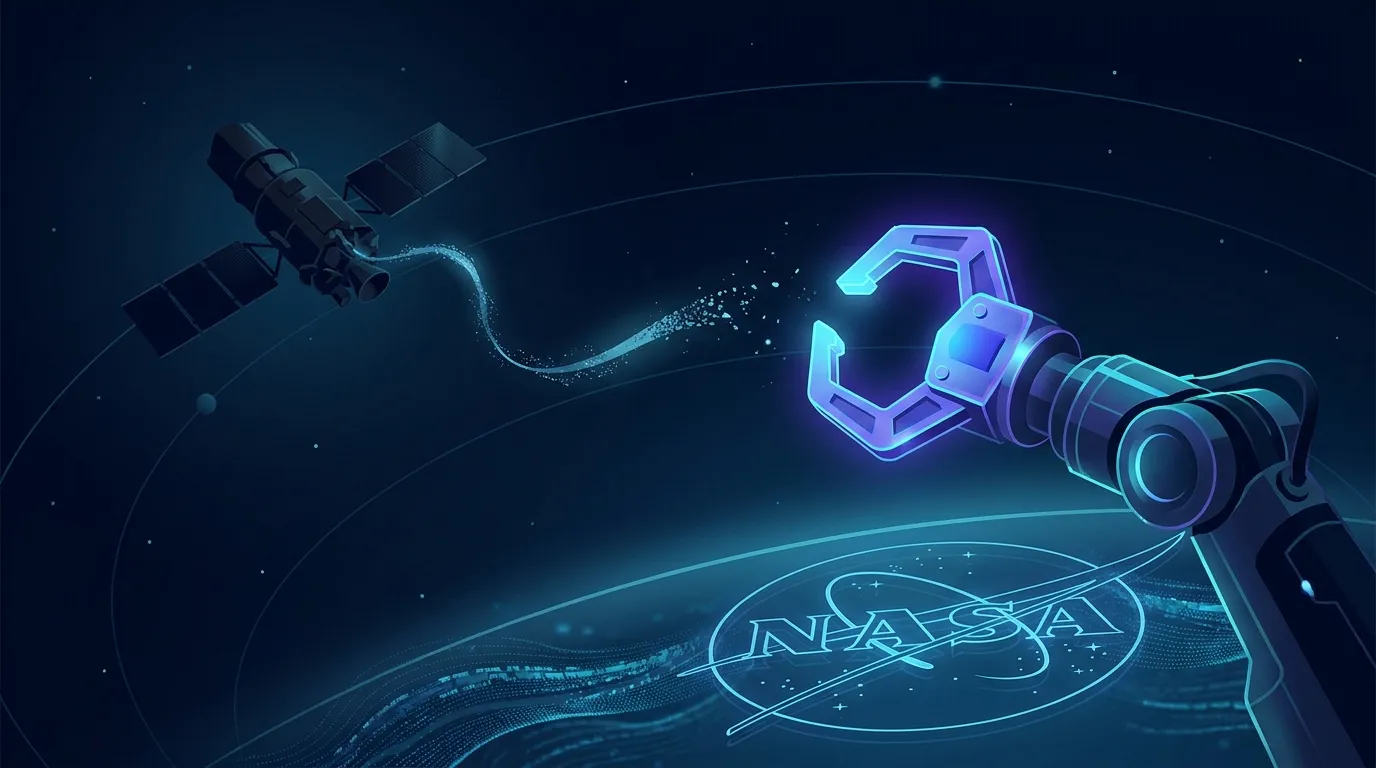
NASA has given up on saving its 22-year-old Swift space observatory, set to burn up in Earth's atmosphere by late 2026. The rescue mission, led by startup Katalyst Space, failed due to attitude control issues on the LINK spacecraft, launched in July.
A technical failure, but lessons for the future
On August 19, 2026, NASA and Katalyst Space announced the abandonment of the rescue mission for the Neil Gehrels Swift Observatory. The LINK spacecraft, launched on July 3 from Kwajalein Atoll, was supposed to capture Swift using three robotic arms and propel it into a higher orbit. However, persistent failures in its attitude control system — two of the three reaction wheels and cold gas thrusters out of service — made the maneuver impossible.
Swift, launched in 2004 for an initial two-year mission, studies gamma-ray bursts, the most powerful explosions in the universe. Its low orbit has been rapidly degrading since 2025 due to increased solar activity. Without intervention, its atmospheric reentry is expected by the end of the year. NASA had awarded Katalyst a $30 million contract in September 2025 to design, build, and launch LINK in under a year — an exceptionally tight deadline.
A calculated risk, with gains nonetheless
The mission remains a test for future on-orbit servicing operations. LINK will still attempt rendezvous and proximity maneuvers with Swift to validate its navigation capabilities. These demonstrations will serve as a foundation for future missions involving refueling, repair, or satellite upgrades.
“NASA must be ready to act fast and take smart risks when the potential payoff justifies it. This isn’t the expected outcome, but it doesn’t change the value of this attempt.” — Jared Isaacman, NASA administratorTranslated from French
“We’ve already learned a great deal, and our job now is to turn these lessons into something lasting.” — Ghonhee Lee, Katalyst Space CEOTranslated from French
 RecommendedNASA captures crater from SpaceX Falcon 9 stage on the Moon
Swift: a scientific legacy, an inevitable end
Swift, costing $500 million, has exceeded all expectations: designed for two years, it operated for 21. Its instruments, capable of detecting and locating gamma-ray bursts within minutes, enabled rapid observations by other telescopes. Its absence will leave a gap in the study of these cosmic phenomena.
NASA states it will continue to operate existing missions to partially fill this gap while seeking new solutions to respond to unexpected cosmic events. Updates on Swift’s fate are available on NASA’s dedicated blog.
The failure of this mission highlights the limits of current technologies, but also their potential. The data collected by LINK, even without a rescue, should accelerate the development of on-orbit servicing capabilities — a strategic issue for the American space industry.
Comments 0
Sign in to join the discussion.
Be the first to comment.