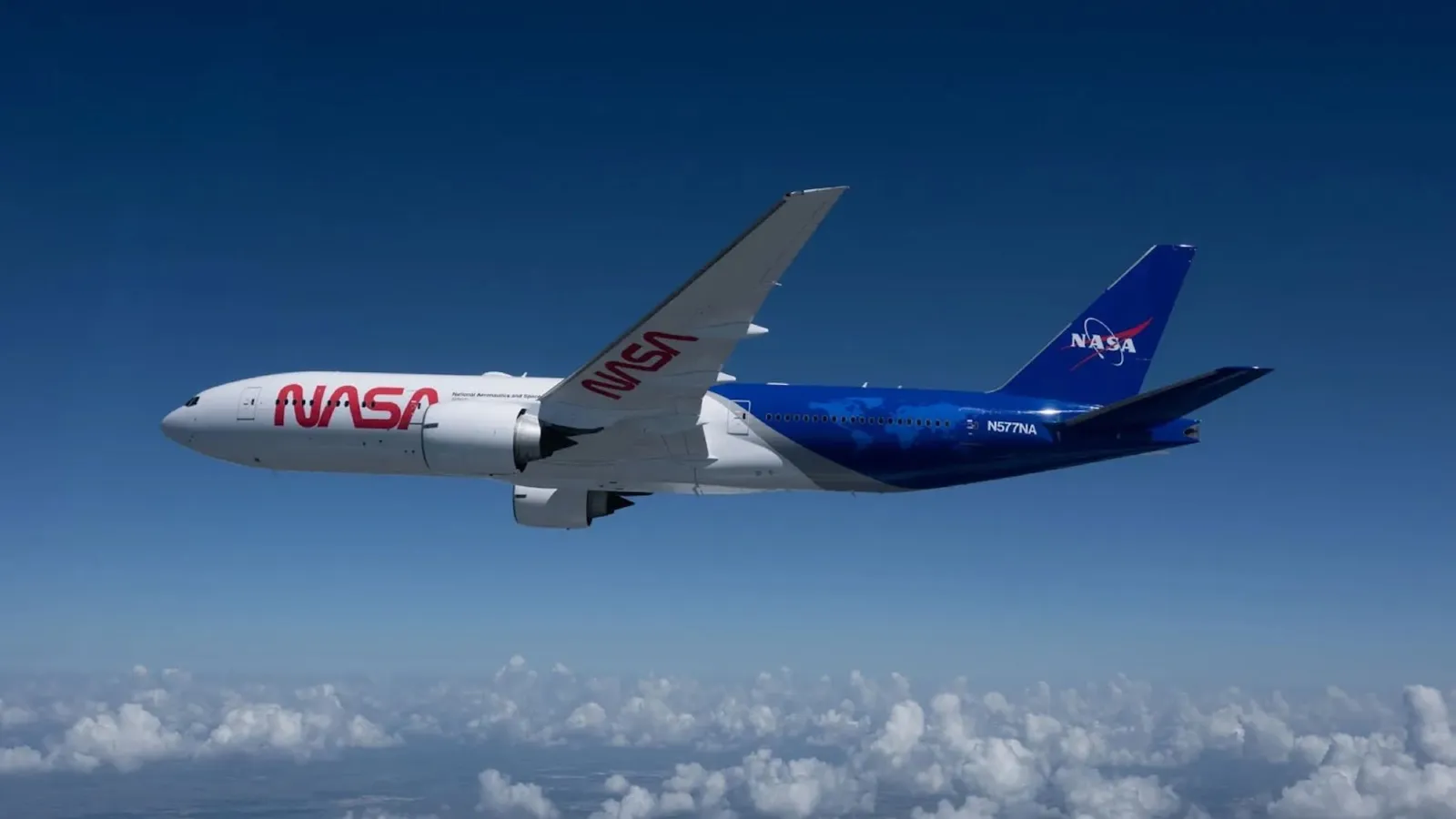
NASA’s Boeing 777-200ER, acquired to replace the DC-8 retired in 2024, has received a new livery in the agency’s colors. This flying laboratory, operational from 2027, will expand NASA’s Earth science research capabilities.
A commercial airliner turned scientific lab
On August 11, 2026, NASA unveiled photos of its freshly repainted Boeing 777-200ER. The aircraft, acquired in 2024 to succeed the Douglas DC-8, left a maintenance center in Texas to join the Langley Research Center in Virginia. Its livery now features the iconic NASA logo on the fuselage, wings, and tail, as well as a world map near the rear of the fuselage.
This B777 is no ordinary plane: once operational in 2027, it will serve as a mobile platform for long-duration scientific missions. With a wingspan of nearly 60 meters, it can carry between 50 and 100 operators on flights of up to 18 hours at an altitude of 13,100 meters. Its 34-ton payload capacity will accommodate a wide range of Earth science equipment.
 RecommendedStarship’s 13th test flight deploys Starlink V3 satellites but remains partial
Extended missions to study the planet
The B777 will carry out diverse missions: sensor development, satellite calibration, data validation, and field studies. This work will help improve models and decision-making in fields as varied as archaeology, atmospheric chemistry, cryosphere, biology, ecology, and oceanography.
Unlike the DC-8, which served for over 35 years, this new aircraft will offer global reach and enhanced technical capabilities. NASA engineers spent several months modernizing its communication systems, data networks, operator facilities, and power sources to prepare it for decades of research.
“This unique flying laboratory will have a truly global reach, enabling data collection for NASA projects, including sensor development, satellite sensor calibration, data product validation, and field studies.” — NASA, dedicated page for the aircraftTranslated from French
With this B777, NASA reaffirms its commitment to maintaining an airborne presence for scientific research. Its entry into service in 2027 will mark a new milestone for Earth observation, with more advanced tools and expanded coverage.



Comments 0
Sign in to join the discussion.
Be the first to comment.