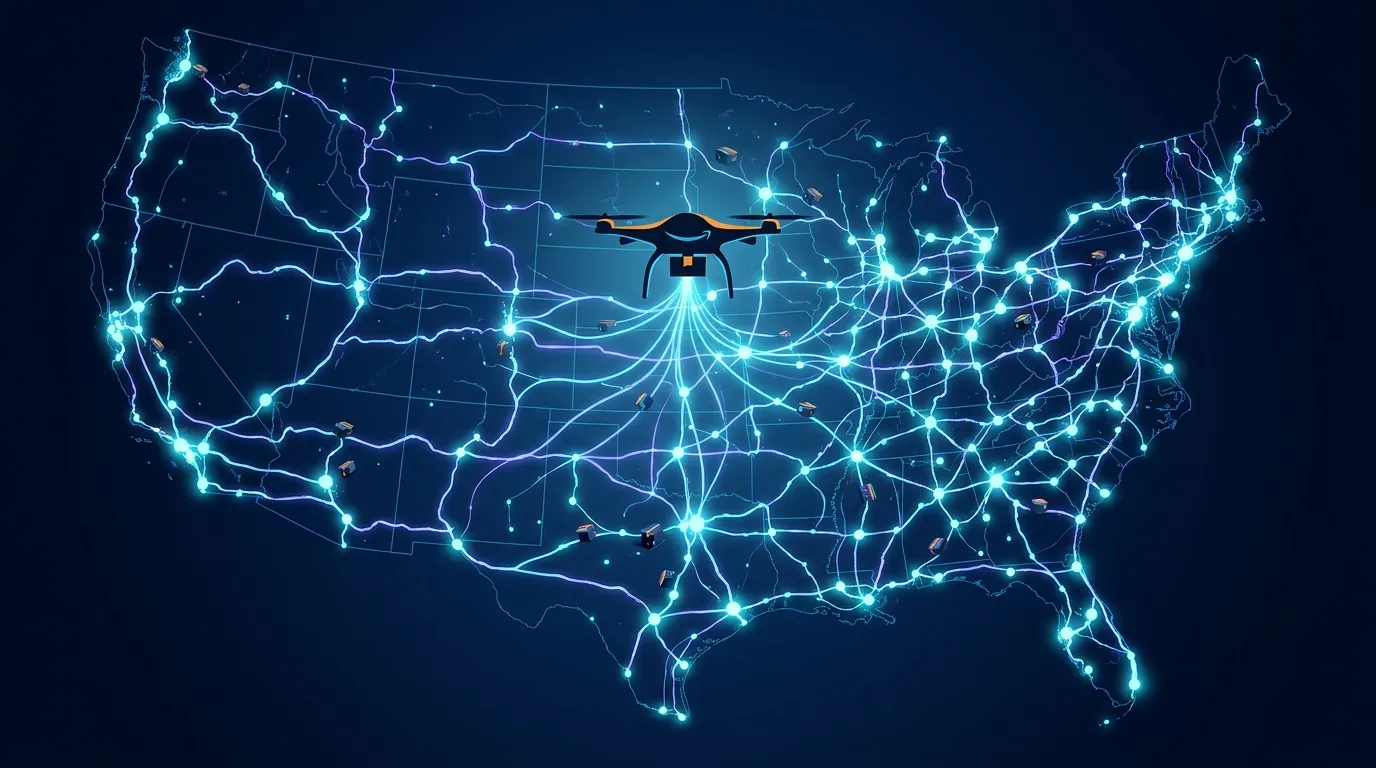
Amazon will expand its Prime Air drone delivery service sixfold to cover nearly 500 US cities by the end of the year. Deliveries, limited to packages under 2.3 kg, are promised in 30 to 60 minutes.
Rapid but targeted expansion
Prime Air is already operational in 11 sites across 10 metropolitan areas, including Phoenix, Tampa, Kansas City, and Houston. By late 2026, Amazon will add cities like Chicago, Cleveland, Atlanta, Syracuse (New York), and Boise (Idaho). Each site covers an area of about 440 km², with deliveries possible in under an hour.
To check if their address is eligible, customers can visit the dedicated page at amazon.com/dronedelivery. Drone deliveries are automatically offered at checkout for eligible orders.
Safety and incidents: a mixed record
Amazon highlights its detection and avoidance system, designed to monitor airspace and obstacles in real time. The drones are equipped with onboard cameras and sensors, with no live video streaming or individual tracking. They are certified under FAA Part 135 regulations, like commercial air carriers.
Yet incidents are increasing. In October 2025, two drones hit a crane in Tolleson (Arizona). In November 2025, a drone severed an internet cable in Waco (Texas). In February 2026, a drone struck a building in Richardson (Texas) before crashing. These accidents triggered FAA and NTSB investigations, which are still ongoing.
“We had trained our algorithms, we felt pretty confident, but in the real world, the performance just wasn’t there. I can tell you it was a humbling experience.” — David Carbon, vice president of Prime Air at AmazonTranslated from French
Noise nuisance and privacy concerns
Residents’ complaints mainly focus on noise. In Hazel Park (Michigan) and Richardson (Texas), locals describe drones flying by “5 to 6 times a day,” compared to “a lawnmower 6 meters above the house.” Some have tried, without success, to ask Amazon to reroute the flight paths.
Privacy concerns are also emerging: users report feeling “watched” by drones flying over their gardens. Amazon states that the cameras are used solely for navigation and obstacle detection, with no recording of people’s movements.
 RecommendedAI hits critical threshold: loss of control, fossil energy, and concentrated power
A booming market
Amazon is not alone. Walmart, partnered with Wing (Alphabet) and Zipline, aims to equip 270 stores by 2027, after surpassing 1 million drone deliveries. Zipline, which has already completed 2.7 million deliveries worldwide, targets 1 million daily deliveries in the US by late 2029. DoorDash obtained its FAA Part 135 certification in July 2026 to launch DoorDash Air.
Electric drones promise fast, low-emission deliveries. But their payload capacity (5 pounds max for Amazon) and sensitivity to weather (strong wind, rain, snow, extreme cold) still limit their use.
The expansion of Prime Air marks a key milestone for drone delivery, but its success will depend as much on technology as on local community acceptance. The coming months will show whether noise nuisance and incidents outweigh the promise of ultra-fast deliveries.
Sources
Amazon — Amazon Prime Air drone delivery expansion
Ars Technica — Amazon aims for delivery drones to reach 500 US neighborhoods by end of 2026
TechCrunch — Amazon’s Prime Air is taking off in nearly 500 U.S. cities
The Verge — Amazon’s drones will soon deliver to nearly 500 US cities and towns




Comments 0
Sign in to join the discussion.
Be the first to comment.