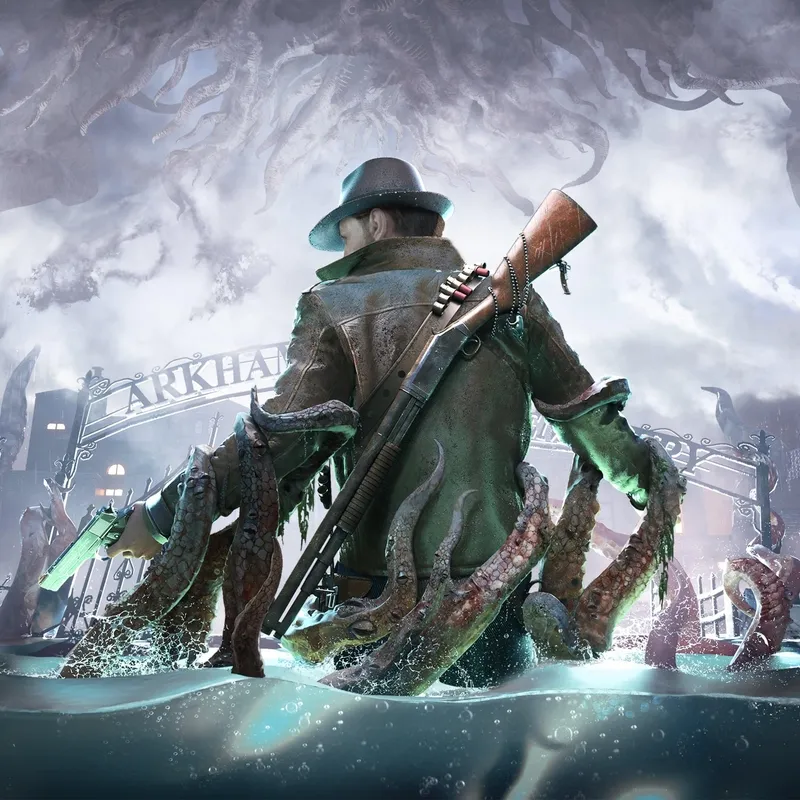
The Sinking City 2 abandons the investigation and open-world elements of the first game to become a linear survival horror experience modeled after Resident Evil. The result is a game that excels in its mechanics but struggles to justify its Lovecraftian identity and disappoints with its lack of narrative ambition.
A radical shift toward survival horror
Frogwares has made a radical change in direction. While the first The Sinking City (2019) blended free investigation and Lovecraftian horror in a flooded open-world city, the sequel focuses on closed environments, combat, puzzles, and an inventory system inspired by Resident Evil. The player takes on the role of Calvin Rafferty, a 1920s occult adventurer determined to save his partner Faye Bennett, who has fallen into a supernatural coma after a botched ritual.
The action takes place in Arkham — a fictional city beloved by Lovecraft, not the Batman asylum. The streets, almost entirely evacuated, are now the playground of worm-like creatures that animate corpses. The game is structured into three main areas (the flooded city, a hospital, a fish market), explored linearly with no backtracking. Combat is more dynamic than in the first game, featuring dodging and enemies that must be taken down by exploiting weak points like pustules or eyes. However, the lack of weapon variety (no grenades, ineffective melee attacks) and repetitive encounters quickly grow tedious.
Investigation sacrificed, atmosphere drowned
Frogwares, known for its Sherlock Holmes games, has reduced the investigative dimension to a bare minimum. The 'investigations' boil down to optional puzzles, often involving codes or objects to be matched in a 'mental palace' — a mechanic inherited from the first game but stripped of its substance. Clues rarely lead to narrative revelations; they mostly serve to unlock locks or chests. The game also abandons the sanity meter, a central element of Lovecraftian lore, in favor of a skill and weapon upgrade system with little impact.
The atmosphere, though well-crafted (damp decor, gothic staging), is frequently disrupted by an endless stream of enemies. Locations like a cold storage room or abandoned coffins barely linger on screen before being overrun by waves of zombies. Side characters, such as Corentin the translator or Ma the fishmonger, remain underused, and the cutscenes struggle to convey the tension expected of a Lovecraftian adventure. The story, centered on Calvin and Faye’s relationship, lacks depth, and the rushed ending leaves a sense of incompleteness.
A clumsy homage to Resident Evil
The Sinking City 2 unabashedly borrows from Resident Evil: grid-based inventory, New Game Plus with bonuses (infinite ammo, for example), and even bosses with weak points reminiscent of the worst moments in Capcom’s saga. But while Resident Evil embraces its B-movie side, The Sinking City 2 tries to take itself seriously — and fails. The game aims to be a monster movie homage, a tragic romance, a Lovecraftian descent into madness, and a war story all at once. References to Russia’s invasion of Ukraine, experienced by Frogwares’ team during development, are integrated via nods (war casualty statistics, real injuries mentioned in a hospital).
"The Sinking City 2 clearly claims to be an action game but lacks the feel, weapon or enemy variety, or vision to fulfill its ambitions."Translated from French
The result is a title that piles up ideas without merging them. As Gamekult points out, these themes 'collide without ever interlocking,' and the game ends up resembling a student copying its master without understanding the lessons.
 RecommendedAI hits critical threshold: loss of control, fossil energy, and concentrated power
Verdict: Better, but not enough
The Sinking City 2 is a technical improvement over its predecessor: combat is smoother, puzzles are better integrated, and exploration, though linear, offers some standout moments. But by abandoning what made the first game unique (investigation, madness, open world), Frogwares delivers a title that drowns in its own contradictions. A Resident Evil of the 1920s, yes, but without the soul — and without Lovecraft.

Comments 0
Sign in to join the discussion.
Be the first to comment.